First Glimpse of Fantasy Secondary Worlds

One of my favourite novels, Jilimar, is part of a new bundle from Bundle Rabbit, curated by Barbara G. Tarn. While it will be released on May 26 over at Bundle Rabbit and all other e-booksellers, it’s available now for pre-order at Kobo, Barnes and Noble and Amazon.

Here’s the Table of Contents:
1. The Crystal Courtesan by Karen L. Abrahamson
2. The Mage’s Grave by Timothy L. Cerepaka
3. Firehearted by Sabrina Chase
4. Singer by Brigid Collins
5. Rider by Diane J Cornwell
6. Jilimar by Marcelle Dube
7. Al-Kabar by Lee French
8. The Path of Water (Quests Book 1) by Barbara G. Tarn
9. Elf Saga, Book 1: Doomsday by Joseph Robert Lewis
10. Twice Against the Dragon by Stefon Mears
11. The Last Giant by Mario Milosevic
12. Dragons’ Choice by Debbie Mumford


You’re not supposed to judge a book by its cover, but…

The job of a good book cover is to make you pick up the book and flip it over to read the back cover. Or click on it to read the blurb. It does that by attracting the eye and providing the right “symbols” to clue you into the book’s genre. If you see a good-looking man and woman on the cover, you would be forgiven for assuming that the book’s a romance. If the man and woman are scantily clad and posed provocatively, it’s probably safe to assume the story contains hot and heavy sex scenes.

As an indie writer, I create almost all my covers. I (usually) enjoy the challenge and I can’t afford to hire a graphic designer for each cover. I mean, really, it would be embarrassing if the graphic designer earned more money on the story than I did.

I know, however, that a bad cover can spell disaster. I also know that “good” and “bad” are subjective. For example, the cover for The Mount by Carol Emshwiller. I had never heard of Ms. Emshwiller when I received her book as part of a goodie bag at a World Fantasy Convention. I looked at it among the 20 or so other books I received and was turned off by the cover. Still, I brought it home. It sat in my bookshelf for years. Every once in a while, I pulled it down and read the cover blurb and then put it back. I just couldn’t get past that ugly (to me—someone else might really like it) cover. Finally, desperate for something, anything, to read, I started reading it.

Well, hot damn. It was a great story—I could NOT put it down. But that cover had put me off so much that I didn’t get to the story for years. That cover failed to do what it was supposed to do, as far as I’m concerned.

While cover art is subjective, a good graphic designer can create a cover that has great appeal. But what if you’re an amateur, like me? You study the genre you’re aiming for. What do those covers look like? What elements do they have in common? Any colours that predominate? Then, trial and error.

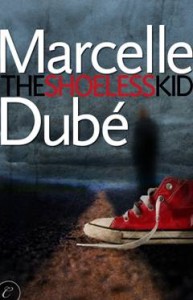
When Carina published my first Mendenhall Mystery, The Shoeless Kid, they used the wonderful John Kicksee as the artist. To say I was blown away by the cover is an understatement.

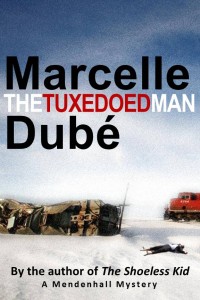
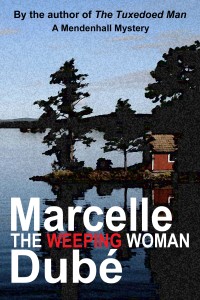
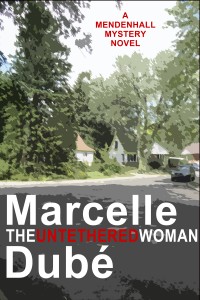
When I decided to continue the series as an indie writer, I knew I wanted to carry on John’s vision. I knew I needed elements of mystery, without going too dark, but I also wanted to carry through the style of title and byline that John had used on Shoeless. What I ended up with was not as gorgeous as John’s original cover, but at least the covers look like they belong in the same series:


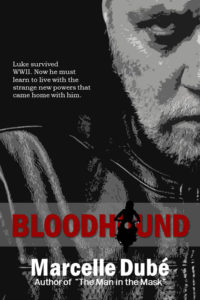
Every once in a while, however, imagination fails me and I can spend weeks (if not months) on a single cover, trying to get it right. “Bloodhound” was published as part of the Superhero Universe: Tesseracts Nineteen anthology. I wanted to put the individual story up for sale, but it needed a cover. Do you think I could find an appropriate image? It was like pulling teeth. The story revolves around a young man who was injured at Antwerp, during World War II. The injury left him with asnomia, or the loss of his sense of smell. Once back home, a series of events reverses the effect, and then some.

I fooled around with ideas for weeks, trying and rejecting, with kind friends looking them over and reacting with “no” to “hell, no!” Here are two of the “best” that got the “uh, no” reaction:


And here’s what I finally ended up with. It may not be perfect, but at some point you have to say, enough, and move on:

What about you? Do you create your own covers? How do you go about it? Any tips…?

(Originally published at Not Your Usual Suspects on February 27, 2017)

facebook | twitter | web

The Winter Mysteries Bundle

Sick of the cold? The snow, sleet, freezing rain? Well, yeah.

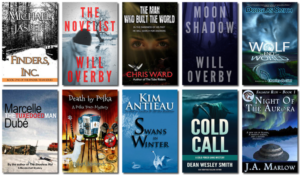
To help us all cope, Bundle Rabbit has come up with a 10-book bundle of mysteries set in winter, curated by Michael Jasper. And I have a book in it! The Tuxedoed Man is part of the Mendenhall Mystery series.

Crimes committed in the heat of the moment, during the coldest time of the year…

This ebook bundle collects mystery novels set in the coldest season of the year, or mysteries containing a strong element of cold (in one sense of the word or another).

The full collection includes the following mysteries:

Two sleuths in the North Carolina mountains spend a snowy week in March searching for people who don’t want to be found…

A haunted author must spend the winter battling his addictions, and worse…

A shapeshifter battles ancient spirits, a covert government agency, and his own dark past in a race to solve a murder…

A desperate man gets a phone call that pulls him back into a world of violence and mystery that he tried to leave behind…

An accidental death, a train wreck and dark secrets in a deadly northern winter places a police chief and her niece in jeopardy…

A crime committed decades ago refuses to lie dormant under the black waters of a lake…

The daughter of the Prince of Polka travels to the polka heartland of New Krakow, Pennsylvania, to solve the mystery of her father’s murder…

A nature-loving woman and a mysterious photographer stand up to a shadowy lumber company that threatens their beloved swans at Turtle Pond…

Two retired detectives search for a friend near a remote Idaho lake, a search that could lead to the most dangerous serial killer in Las Vegas history…

Two brothers must unravel the weird and dangerous secrets of Salmon Run, Alaska: a place of wild animals, wild lands, and wild inhabitants…

Special, limited-time offer:
So stoke that fire against the chill in the air, put up your slippered feet, and start reading one!

Available only at BundleRabbit, until March 20: Pay a minimum of $3.99 and receive 5 of the 10 novels.

Or pay the minimum of $6.99 and receive all 10 ebooks. This option is also available at kobo, amazon, barnes and noble and itunes.

More praise for Shelter

From Kristine Kathryn Rusch’s November 2016 Recommended Reading List:

Dubé, Marcelle, Shelter, Falcon Ridge Publishing, 2016. Marcelle Dubé has long been one of my favorite writers. Her stories are quietly deceptive. They creep up on you, and make you think.

Ash Gantry is on the run from her abusive husband. She finally finds a place she wants to stay, but she has to confront demons—hers as well as some that exist in the town itself.

Shelter is exactly the kind of novel I’d craved for a long time. Not romantic suspense, exactly. More like a gothic women’s fiction novel, complete with ghost.

The novel has a marvelous sense of dread. The dread got so severe that I finally had to make a decision: set the novel aside or read it on one lump to the end. Of course, I opted to finish it. Marvelous book, dark and rewarding.

Recommended Reading List: November 2016

A Good Read for Halloween Night

From What’s Up Yukon, October 26, 2016, reprinted with permissionshelter-sw-cover:
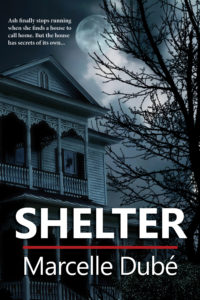
Yukoner Marcelle Dubé´s newest book is a ghost story

by Elke Reinauer

Do ghosts exist? For some they do.

The main character in Marcelle Dubé´s novel, Shelter, moves into a haunted house in a small town in Ontario.

Dubé started the story as a gothic novel and in the end it became a ghost story.

Marcelle Dubé is well known in the Yukon and she usually publishes one or two books a year. One could think that she is a writer who works fast, but not this time. Lately she had to suffer what all writers have to go through from time to time: writer`s block. A writing workshop helped her to get out of it.

“I could not write a word – for months. I thought that was it for me. But something that happened in the workshop kept coming back to me — a ghost experience, of a sort,” she says.

In her blog Dubé tells about her ghost experience. During the workshop, she stayed at an old hotel, which was haunted. Two people she knew well, who had also slept there, told her they had seen ghosts there. Friendly ghosts, who would show up, but were harmless, they said.

Dubé´s first reaction was to laugh, she tells in her blog article. She sees herself as a rational woman, even though as a kid she had returning dreams of ghost and monsters. She outgrew them and is using her imagination about them in her writing.

Dubé didn`t see a ghost in this hotel room, but she was scared at night, she writes. Back home she would wake up at night, wondering if there was somebody or something in the darkness.

“The experience bothered me, as I am not subject to those kinds of fears, so finally I decided to write about it, as an exorcism. “And once I started, I raced through to the end. It was most satisfying,” she says about the writing process of Shelter.

Shelter is a story about Ash, a woman who’s fleeing domestic violence and abuse. She is already exhausted and scared, and now she has to deal with a ghost.

Reading the first chapters, one can feel pity for Ash, who is wounded by her past. Dubé writes very well and empathically, but she switches perspective quite often. The reader jumps from Ash`s perspective into the head of her realtor Maddie, who is showing Ash the haunted house. It can be tiring for readers to switch perspectives after one page. Some readers might wish to stay longer in Ash`s head and get to know her better. But as the story unfolds, Dubé catches her readers with suspense.

Why did Dubé decide to write about domestic violence? It is not an easy topic.

“I have no idea how Ash came to me, or why she was running from an abusive situation. It’s not anything I have ever experienced, and I had to rely on experts to (hopefully) get the details right,” the author answers.

The whole story came to her as the cure for writer`s block. Also during the writing process she lost her fear about ghosts: “It worked. I’ve just returned from the haunted hotel I was at a year and a half ago, and I am happy to report that I slept very well.”

Do ghosts exist? They do in Dubé`s novel Shelter, a good read for spooky Halloween night.