How old is too old?

I just attended a talk by a renowned Canadian editor and publisher by the name of Douglas Gibson. He edited the likes of Robertson Davies, W.O. Mitchell, and Margaret Atwood… CanLit royalty. What was most interesting to me was the fact that he is “of a certain age.” He retired from editing and publishing at age 65, then reinvented himself as a writer, then as a performer. Now, at 72, he travels the country in a one-man play in which he dishes about the famous writers he edited.

A couple of years ago, I saw Maria Muldaur at the Harvest Jazz and Blues Festival in Fredericton, New Brunswick. (Never been? Oh, you have to go. It’s a fabulous festival.) I’d always liked Maria Muldaur but had never seen her perform. She had to be escorted onto the stage (poor eyesight, I think). That’s when I took a look around the audience and noticed the predominance of gray and white heads. Hoo boy. I braced myself for a nostalgic trip led by a woman clearly past her prime.

Was I ever wrong. Maria Muldaur, also 72, blew me (and everyone else) away. She might have been past her prime, but she sure as heck found another prime along the way.

A few weeks ago, I read a post by Dean Wesley Smith in which he referenced a comment from a reader who regretted starting to write so late in life. Dean understood completely. He spoke about his own experience of feeling like he should have been writing his own, original work much earlier than he did. Then he asked, So what?

That’s my question, too. So what if you started writing at 50 or 60 or 90? Is it what you want to be doing? Does it bring you joy? Fill your well? Give you a reason to get up? Then who cares how old you are when you start?

I admit to a few moments of doubt. Moments when I wonder why I should bother, because really, isn’t it rather late? But that’s wrong-headed thinking. We should be grateful to have discovered our passion at all. Many people go through life puttering, with no idea what that fire in the belly feels like.

Besides, there are advantages to being an older writer. The kids are grown and (mostly) out of the house. You’re no longer the family chauffeur/breadwinner. Your career may be starting to wind down. All of which translates to more time to dedicate to learning your craft, practising and creating.

I’m approaching 60 and some days I feel like life is galloping by and it’s all I can do to hang on. I’ve got so many stories to write, and so much to learn about this writing stuff… I figure another 40 years ought to do it. Maybe.

Ask yourself how old you would be if you didn’t follow your dream, whatever that is. That’s right. You’d still be the same age, only not as happy. At least now, you’re doing what you were meant to do.

I find myself inspired by Douglas Gibson, Maria Muldaur, and Dean Smith. Who are your inspirations?

facebook | twitter

Originally published on Not Your Usual Suspects, January 25, 2016
A Trailer for Superhero Universe

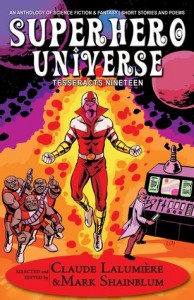
How cool is this? Edge Publishing has launched a trailer for the upcoming release of Tesseracts Nineteen: Superhero Universe, edited by Claude Lalumière and Mark Shainblum

Superhero UniverseRelease Dates:
Pre-Order Kindle E-book:
Jan. 11, 2016 thru Jan. 24, 2016
Exclusive Kindle E-book: Jan. 25, 2016 thru April 17, 2016
E-book Everywhere: April 18, 2016
Print Canada: March 14, 2016
Print USA: April 18, 2016

You can see the trailer here.


Confusing Times

From my November 20, 2015 blog post on Not Your Usual Suspects:

Traditional publishers and agents have been advising writers to specialize in one genre only for decades. Forever, really. The reasons are many, some maybe even valid:

  1. If publishers spend time and money marketing your science fiction book, they want to build on that, rather than start all over with your historical romance.
  2. You’ll confuse (and probably tick off) the reader who goes looking for your noir mystery only to find herself reading your latest slasher horror.
  3. You’ll spend longer trying to develop your writer “brand” if you split yourself among genres.

Indie publishing has placed all kinds of decisions in writers’ hands, including this one. Now that they don’t have to bow to a publisher’s will, they have to decide: Should they? Shouldn’t they?

As with any creative or business decision, you have to weigh the advantages and disadvantages.

For me, it boils down to the reason you write. Is it to make money? (A very valid reason.) Is it because you love writing so much you would do it whether or not it made money for you? (Also very valid.)

There’s another question you need to ask yourself: what’s the cost (creatively, emotionally, even physically) of NOT writing the story that’s in you to write?

I think you should write whatever damned book you want to write. While you owe your readers something, you also owe yourself. You have the right to challenge yourself, to experiment, to fill every little bit of your writer’s soul. After all, what’s the point of spending all that time and effort if you’re not having fun?

One caveat: Don’t mislead your reader. If you don’t use a pen name, be up front about your different genres (have different tabs on your web site for science fiction, romantic suspense, horror, etc.). Even an “open” pen name lets the reader know that these stories aren’t the same as the ones under your own name. Some readers will follow you across all your genres, while others will only read you in one genre. And that’s okay.

Remember: If you use a secret pen name, it can exacerbate the issue. You’ll be working to build two names (or three, or four), rather than just yours.

Here’s a mini-list of well-known writers who write in two or more genres:

Walter Mosley: Literary fiction, science fiction, political monographs, YA, mystery

Nora Roberts/J.D. Robb: Romance, romantic suspense, science fiction/police procedural

Joyce Carol Oates: Gothic, horror, suspense, mystery/crime, romance, historical, fantasy, realism, surrealism…

Ian Fleming: Spy novels (James Bond) and children’s (Chitty Chitty Bang Bang)

Stephen King: What doesn’t he write?

Elmore Leonard: westerns, crime, suspense, screenplays

Nicola Griffith: science fiction, thrillers, historical

Kristine Kathryn Rusch: science fiction, romance, fantasy, mystery

Can you think of any others?

web | facebook | twitter

We have a cover!

Superhero Universe

Here’s the cover for Tesseracts Nineteen: Superhero Universe. It’s edited by Claude Lalumière and Mark Shainblum, and published by Edge Publishing. The cover artist is Jason Loorox (Jason Loo), creator of the brilliant Indy superhero comic The Pitiful Human Lizard.

Superhero Universe will be available in March 2016. My short story, “Bloodhound,” is in it.

This place is in my blood…

Ahem. Elke Reinauer wrote me up in an article in What’s Up Yukon. I’m displaying a definite lack of humility here, but what the heck. I’m chuffed! And by the way, the photo is by my brother, Photographie Eric Dubé, armourer, videographer and photographer extraordinarie.

This place is in my blood

Yukoner Marcelle Dube publishes her first short story collection

by

September 10, 2015

– See more at: http://whatsupyukon.com/Arts-Entertainment/literature/this-place-is-in-my-blood/#sthash.fkoOREiG.dpuf